 Uyuni Salt Flats Trips
Uyuni Altitude Sickness: What Height You Face and How to Handle It
Uyuni altitude sickness is a real risk on a Salar de Uyuni trip, because the salt flat itself sits at 3,663 m (12,018 ft) and the 3-day southwest route climbs far higher. This guide gives the elevations of Uyuni town, the salar, the lagoons and the border pass, the CDC guidance on how fast you should climb, why starting from San Pedro de Atacama is the hardest jump of all, and which tours carry oxygen. For what the tours cost, see the Salar de Uyuni tour catalog. The honest headline: the salar day trips keep you at 3,656-3,700 m, while the second and third days of the lagoons route push every traveler above 4,200 m. If you came for the flat itself, compare the one-day loops and read the route notes with the heights in mind.
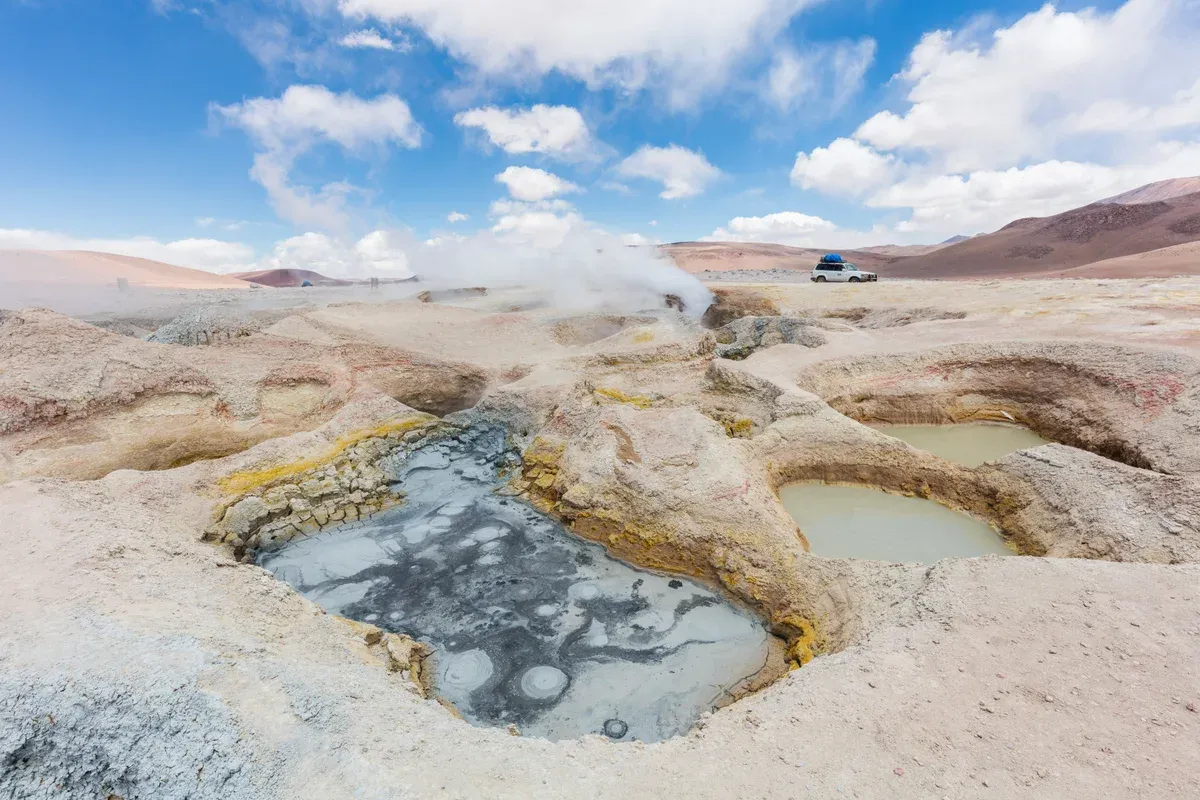
The mud pools of Sol de Mañana. Photo: Diego Delso, CC BY-SA 4.0, via Wikimedia Commons
Quick answer Altitude on an Uyuni trip
Uyuni sits at roughly 3,656-3,700 m (sources conflict on the exact town elevation) and the salar at 3,663 m (12,018 ft), so even a one-day tour puts you above the CDC's 3,000 m threshold. The real altitude risk is the 3-day southwest route, which runs between 4,200 m and 5,400 m in the Eduardo Avaroa reserve, with the Sol de Mañana geysers at about 4,900 m. Starting from San Pedro de Atacama is the hardest jump because that route reaches the 4,480 m Hito Cajón pass, Laguna Verde and the geysers before it ever reaches the salar. The CDC advises limiting sleeping-altitude gains to about 500 m per night above 3,000 m.
Key takeaways
- See every altitude on the route in the table in How High You Actually Go.
- The 3-Day Tour to the Uyuni Salt Flat and Colored Lagoons is a route that takes you to about 4,900 m, and its listing warns off passengers with altitude sickness risk.
- Coming from Chile? Read the day-one climb in the San Pedro de Atacama to Uyuni crossing guide.
- Arriving through La Paz? Plan the connection with the La Paz to Uyuni guide.
How High You Actually Go
Altitude on an Uyuni trip is not one number. A day loop stays at 3,656-3,700 m, while the lagoons route spends two days between 4,200 m and 5,400 m.
Uyuni Town and the Salar
Sources disagree slightly on Uyuni's elevation, and it is worth knowing the spread. Wikipedia gives 3,700 m for the town, 3,663 m for the salar surface, 3,665 m for Joya Andina airport, and operator pages commonly cite 3,656 m. Any of these figures puts you well above the 3,000 m line where the CDC's ascent rules start to apply.
The good news is the salar itself is flat to within less than one meter across its 10,582 km² surface, so walking on the salt costs no extra effort. Incahuasi Island sits at 3,656 m in the middle of the flat, and its short cactus trail climbs for only about 15-20 minutes. A one-day jeep loop like the Salt Flats Highlights Jeep Tour with Lunch keeps you in this band the whole time.
The CDC also warns against jumping from below 1,200 m to a sleeping altitude above 2,750 m in a single day, which is exactly what a flight from the coast to Uyuni does.
The High Points of the 3-Day Route
The southwest circuit through the Eduardo Avaroa reserve is a different animal. The reserve covers 714,745 hectares with altitudes between 4,200 m and 5,400 m. Laguna Colorada lies at 4,278 m, Laguna Verde at 4,310 m, and the lagoon chain of Cañapa, Hedionda and Chiar Khota runs roughly 4,100-4,700 m.
The Sol de Mañana geyser field is the day-three high point at about 4,900 m, though sources conflict: Wikipedia says about 4,900 m, some operators say 4,850 m, and a sign at the site reportedly reads about 4,905 m. Travelers crossing to Chile finish at the Hito Cajón pass at 4,480 m. Every one of these figures is at least 1,100 m above the CDC's 3,000 m threshold, and you sleep at Laguna Colorada on night two of routes that end back in Uyuni or at the border.
| Point on the trip | Elevation | Why it matters |
|---|---|---|
| Uyuni town / the salar | 3,656-3,700 m (sources conflict) | Day tours stay in this band, above the 3,000 m CDC threshold |
| Isla Incahuasi | 3,656 m | Short 30-45 minute trail, no extra climb |
| Laguna Colorada (night 2 refuge) | 4,278 m | You sleep here on the lagoons route |
| Laguna Verde | 4,310 m | Day 3 stop before the border |
| Hito Cajón border pass | 4,480 m | Bolivian exit point for Chile crossings |
| Sol de Mañana geysers | about 4,850-4,905 m (sources conflict) | Highest stop on the route |
| Eduardo Avaroa reserve range | 4,200-5,400 m | The band the 3-day route operates in |
What the Fees Have to Do with It
The lagoons route crosses the Eduardo Avaroa reserve, and that is where the cash fees come in. Foreign visitors pay 150 Bs (about $13) at the reserve entrance and around 30 Bs (about $3) at Incahuasi Island, both in cash and both usually excluded from the tour price. The listing for the 3-Days Tour to the Uyuni Salt Flat and Colored Lagoons +Sunset+Mirror Effect prices at $290 but adds $62 of mandatory extras, so $352 per person, with park entrances and the sleeping bag still on top.
That price picture is separate from the health one, but the two meet in one place: the tour listing itself advises passengers with altitude sickness risk, pregnancy or back problems against this route. If you decide the high route is not for you, a one-day salar loop keeps you under 3,700 m and still shows you the flat. The one-day Uyuni salt flat tours keep the whole trip in that lower band.
Sources: Salar de Uyuni on Wikipedia and UK travel advice for Bolivia.
What the CDC Says About Climbing This Fast
The US Centers for Disease Control and Prevention publishes clear ascent rules for high-altitude travel. Measured against them, the standard Uyuni itineraries climb too fast.
The Ascent Rules
The CDC Yellow Book advises that above 3,000 m you should move your sleeping altitude by no more than about 500 m (1,650 ft) per night, and add an extra acclimatization night for every 1,000 m (3,300 ft) of further gain. It also warns against jumping directly from below 1,200 m to a sleeping altitude above 2,750 m in a single day. Now hold the standard 3-day Uyuni tour against that.
Night one is a salt hostel, or San Juan on one listing, and no elevation is published for either. Night two is at Laguna Colorada at 4,278 m. Measured from Uyuni town at 3,656-3,700 m, that is a gain of roughly 580-620 m in sleeping altitude, above the CDC's 500 m guidance.
The Protective Staging Fix
The CDC also gives the fix. Acclimatizing for a minimum of 2-3 nights at around 2,450-2,750 m before going higher is markedly protective against altitude illness. Nothing on the Uyuni circuit sits in that band.
Uyuni town, at 3,656-3,700 m, is already about 900 m above the top of it, and the sources used for this guide give no elevation for La Paz or Sucre, so check the figure for any staging town before you count on it. What the CDC rules do make clear is where your nights matter most. The guidance is built around sleeping altitude, and it asks for an extra night for every 1,000 m of further gain above 3,000 m.
A day tour that returns to Uyuni puts your bed back at 3,656-3,700 m that evening. The 3-day route moves your bed to 4,278 m on night two, and that step is the one to prepare for with extra nights in Uyuni first.
Symptoms and When They Are Serious
The sources behind this guide carry the CDC's ascent rules, not its symptom list, so this page gives no medical dosing advice. What the tour listings themselves state is the practical picture. The 3-Day Uyuni Salt Flats Tour ending in San Pedro de Atacama says it is not suitable for children under 3, pregnant women or people with back problems, and warns that the vehicle may occasionally stop briefly due to altitude.
The Andes Salt Expeditions lagoons listing advises against the route for passengers with altitude sickness risk, and the express tour from La Paz lists itself as not suitable for people with altitude sickness. If you feel worse at altitude, tell your driver early. On the southwest circuit the lowest ground in reach is Uyuni town at 3,656-3,700 m, a long jeep ride back, and the route forward to the border at 4,480 m is not lower.
Uyuni Altitude Sickness on Video
The height and the cold of the Uyuni trip, useful for judging how hard the altitude feels. Third-party video by Altitude Travel. We did not shoot it and have no relationship with the creator.
Why Starting from San Pedro de Atacama Is the Hardest Jump
The Chile-to-Bolivia direction inverts the usual acclimatization logic and produces the steepest single-day gain on any Uyuni itinerary.
From San Pedro to the 4,480 m Pass on Day One
The Chile-to-Bolivia direction puts the highest ground first. Chilean customs are completed in San Pedro town itself, about 45 km (28 mi) from the Hito Cajón pass, and Bolivian customs are processed at the pass summit at 4,480 m (14,700 ft). So a traveler who slept in San Pedro is standing at 4,480 m within the first hours of the tour.
On the 4-day round trip from San Pedro, the route order runs Laguna Blanca, Laguna Verde at 4,310 m, the Salvador Dalí Desert at about 4,750 m, the Polques hot springs at about 4,400 m and the Sol de Mañana geysers near 4,900 m, then Laguna Colorada at 4,278 m, all before the salar. The listing starts with an early morning pickup from your San Pedro hostel. There is no staging night at Uyuni's elevation on that route at all.
If you are planning that direction, the crossing logistics and alternatives are covered in the San Pedro de Atacama to Uyuni guide.
The Uyuni Direction Is Gentler
Running the route the other way around, from Uyuni to Chile, gives you the salar day first at 3,663 m, then a night at a salt hostel, then the climb to Laguna Colorada at 4,278 m. You gain altitude across two days instead of meeting the highest ground at the start. The Uyuni: 3-Day Salt Flats Tour ending in San Pedro de Atacama works that way, with night two in the Laguna Colorada Refuge, a shared dormitory with 2 to 6 beds and no heating on that night, and it reaches San Pedro at about 12:30 PM on day 3.
If altitude worries you, direction is one of the strongest levers you have, though the listings differ in price and length: $450 for 3 days from Uyuni against $332 for the 4-day round trip from San Pedro.
Acclimatizing in La Paz, Uyuni or Sucre First
Where you sleep before the tour decides more about altitude sickness than anything you do during it.
Arriving Through La Paz
Many travelers reach Uyuni from La Paz, and the altitude sources used for this guide give no elevation for La Paz itself, so do not assume it works as a low staging stop. The overnight bus is a 9-10 hour ride over about 569 km, departing around 9:00 PM and arriving early in the morning. Options run from $44 for the Todo Turismo Semicama Master Suite to $49 for the Cama Ejecutivo, with dinner and breakfast on board.
The BoA flight leaves La Paz at 07:10 and lands in Uyuni at 08:10, and since tours typically start around 10am, a same-day start is possible. That speed is the problem: it puts a full tour into your first hours at 3,665 m. Plan the connection with the La Paz to Uyuni guide and build at least one full Uyuni night into it.
Uyuni as the Staging Town
Uyuni town at 3,656-3,700 m is where you will sleep before almost any tour anyway, so treat those nights as the acclimatization they are. The CDC's extra-night rule is written for every 1,000 m of gain above 3,000 m, and night two of the lagoons route sits about 580-620 m above Uyuni town. Two nights in town before that route is in the spirit of that advice.
Travelers coming up from Argentina cross at Villazón and La Quiaca, where both towns already sit above 3,400 m, then continue by bus for 5-6 hours to Uyuni or by train in about 7-7.5 hours. Sucre is about 8 hours from Uyuni by bus over 229 km (142 miles), and Potosí about 4 hours over 148 km, but neither town's elevation is given in the sources here.
Day Tours as a Test
A one-day salar loop is a low-stakes way to learn how your body handles 3,663 m before committing to three days above 4,200 m. The Salar de Uyuni Tour 1 day with Sunset runs 9 hours, stays on the flat and ends back in Uyuni the same evening, so if you feel unwell you sleep at 3,656 m that night instead of at 4,278 m. That is a real safety valve.
Shared full-day loops run from $78 to $95 per person before the Incahuasi fee, a modest cost for what you learn about yourself.
Oxygen on Tours, Coca Tea and the Cold
Not every listing carries oxygen, the local remedy has no clinical evidence behind it, and freezing refuges make everything worse.
Which Tours Carry Oxygen
Oxygen is named explicitly in only some listings. The 3-Day Tour to the Uyuni Salt Flat and Colored Lagoons includes an oxygen tank on the second night, the one at Laguna Colorada, at a $290 listed price or $352 with mandatory extras. The San Pedro de Atacama: 4-Day Uyuni Salt Flats Tour states that an oxygen bottle is included, priced at $332 for the 4-day, 3-night round trip.
The other lagoons listings do not mention oxygen in their inclusions, which is not the same as saying no driver carries a bottle, but it is not confirmed either. When you book, treat oxygen as an inclusion you verify rather than assume, and ask the operator directly before paying.
Coca Tea, Honestly
Coca leaf and coca-leaf tea are legal in Bolivia and are the traditional local remedy offered to newly arrived travelers against soroche, the local word for altitude sickness. The peer-reviewed evidence for it is thin: a review in the Tropical Diseases, Travel Medicine and Vaccines journal notes that no clinical trial evidence supports the practice. Drinking a warm cup is pleasant and harmless for most people, and it is offered everywhere in Uyuni.
Just do not mistake it for acclimatization, and note the legal point the same source raises: coca products become illegal narcotics under international law once carried out of the Andean coca-producing countries, so drink the tea in Bolivia and do not pack the leaves. The one exposure on this route that no drink changes is the cold at night.
Cold Nights Make Altitude Harder
Cold does not cause altitude sickness, but a freezing, sleepless night at 4,278 m will make any altitude symptom feel worse. The ERA5 climate archive gives June-August average nighttime lows of about -3.7°C to -4.0°C at Uyuni town, and the reserve's higher ground at 4,200-5,400 m runs colder on the same nights. The 3-Day Uyuni Salt Flats Tour ending in San Pedro de Atacama describes its second-night lodge as basic with no heating, with hot showers working about 75% of the time, and includes a sleeping bag from May to September for the winter nights.
On the Andes Salt Expeditions lagoons tour the sleeping bag rental is excluded from the $352 total. Warm layers are not optional on this route, and the season-by-season breakdown is in the best time to visit Uyuni guide. What to put in the bag is a separate question, answered in the Uyuni packing list.
When to Turn Back
The southwest route has limited exit options, so the decision to descend has to be made early and stated clearly.
The Geography of Descending
On day two of the lagoons route you are at Laguna Colorada at 4,278 m, and the next day's stops climb to the geysers near 4,900 m before dropping to Laguna Verde at 4,310 m or heading to the Hito Cajón pass at 4,480 m. The realistic descent is back north toward Uyuni at 3,656-3,700 m, a long jeep ride, or on into Chile once the border is crossed, with San Pedro town about 45 km from the pass. That asymmetry is why timing matters.
Symptoms that get worse rather than better overnight at 4,278 m are the point to tell the driver, before the next morning's climb toward 4,900 m. One listing already warns that the vehicle may stop briefly due to altitude, so drivers on this circuit expect the conversation.
Choosing a Route That Matches Your Body
The honest framing for the booking decision: if you have never slept above 3,000 m, or you have had altitude illness before, the 3-day lagoons route is the part of an Uyuni trip that carries the risk, not the salt flat. A day loop keeps you at about 3,663 m, ends in town, and still delivers the salt crust, the mirror in the wet months and Incahuasi when it is reachable. The lagoons, flamingos and geysers are the reward for a night at 4,278 m and a morning near 4,900 m, and they are covered in detail in the Laguna Colorada guide so you can weigh what you would be giving up.
To weigh the two side by side, compare one-day and three-day Uyuni tours by route and height. There is no shame in the one-day choice, and it is the safer trip for pregnancy, back problems and altitude risk alike, which is exactly what the tour listings themselves advise.
Altitude Do's and Don'ts for an Uyuni Trip
Practical rules drawn from the CDC guidance and the realities of the route.
Do
- Do sleep in Uyuni town for at least one night, and preferably two before the lagoons route, because the town's 3,656-3,700 m elevation is your acclimatization, planned or not.
- Do pick the Uyuni-to-Chile direction rather than San Pedro to Uyuni if altitude worries you, because it spreads the climb over two days instead of one morning jump to 4,480 m.
- Do book a one-day salar tour first as a test of how you handle 3,663 m before committing three days above 4,200 m.
- Do ask the operator directly whether oxygen is on board, since only some listings, such as the Andes Salt Expeditions 3-day route and the 4-day San Pedro round trip, state oxygen as included.
- Do tell the driver early if symptoms worsen, because the only reliable treatment is descent and the descent options are long.
Don't
- Don't start a tour off a morning flight if you can avoid it, because the 07:10 La Paz flight lands at 08:10 and a same-day tour puts a full day at 3,665 m into your first hours there.
- Don't count on coca tea as protection, since the published evidence finds no clinical trial support for it as an altitude remedy.
- Don't underestimate the cold at night, where June-August lows average about -3.7°C to -4.0°C at Uyuni town, the refuges run colder, and one listing says its second-night lodge has no heating.
- Don't push through a worsening headache or vomiting at 4,278 m, because the route climbs further toward 4,900 m before it comes down.
- Don't skip the cash, since the reserve entrance of 150 Bs (about $13) and the Incahuasi fee of around 30 Bs (about $3) are paid in cash at points already at high altitude.
Uyuni Altitude Questions
What is the altitude of the Salar de Uyuni?
The salar surface sits at 3,663 m (12,018 ft) above sea level, and sources place Uyuni town itself between 3,656 m and 3,700 m, a conflict the sources never settle. Incahuasi Island in the middle of the flat sits at 3,656 m. You can see how these heights sit on the route in the altitude table, or read more about the flat in the Salar de Uyuni guide.
Can you get altitude sickness on a one-day Uyuni salt flat tour?
Yes, it is possible, because 3,663 m is well above the 3,000 m line where the CDC's high-altitude guidance begins, though a day at that height that ends back in Uyuni town is the mildest exposure an Uyuni trip offers. The CDC also warns against jumping from below 1,200 m to a sleeping altitude above 2,750 m in one day. The safer plan is a night in Uyuni first, as covered in the acclimatization section.
How high does the 3-day Uyuni lagoons route go?
The Eduardo Avaroa reserve, where the route runs, spans 4,200 m to 5,400 m. Fixed stops include Laguna Colorada at 4,278 m, Laguna Verde at 4,310 m, the Hito Cajón border at 4,480 m and the Sol de Mañana geysers at about 4,850-4,905 m, with sources conflicting on the exact geyser figure. The route itself is described stop by stop in the Laguna Colorada guide.
Is it worse to start the Uyuni tour from San Pedro de Atacama?
For altitude, yes. The route from San Pedro reaches the 4,480 m Hito Cajón pass, Laguna Verde at 4,310 m and the geysers near 4,900 m before it reaches the salar, with no staging night at Uyuni's elevation. The Uyuni-to-Chile direction spreads the gain over two days. The crossing options in both directions are compared in the San Pedro de Atacama to Uyuni guide.
Do Uyuni tours carry oxygen?
Some do, but you have to check. The Andes Salt Expeditions 3-day lagoons tour includes an oxygen tank on the second night, and the 4-day White & Green tour from San Pedro de Atacama lists an oxygen bottle, while the other listings do not mention oxygen at all, which is not confirmation either way. Ask the operator before booking. If you want the lower-altitude alternative instead, compare the one-day Uyuni salt flats loops.
Does coca tea help with altitude sickness in Uyuni?
Coca tea is legal in Bolivia and is the traditional remedy for soroche, offered to travelers everywhere in Uyuni. A peer-reviewed review finds no clinical trial evidence supporting the practice, so treat it as a warm drink, not a treatment. The CDC's evidence-based advice on staging your ascent is summarized in the CDC rules section.
How many nights should I acclimatize before the lagoons tour?
The CDC advises 2-3 nights at around 2,450-2,750 m before going higher, and no more than about 500 m of sleeping-altitude gain per night above 3,000 m. Since the lagoons route sleeps at about 4,278 m on night two, two nights in Uyuni at roughly 3,656-3,700 m before departure follows the spirit of that advice. Getting there and timing the arrival is covered in the La Paz to Uyuni guide.